How to Create a Realistic Budget for Your Home Renovation Project
Reading time: 14 minutes
Ever stood in your outdated kitchen, coffee in hand, dreaming of a gleaming new backsplash and custom cabinetry — only to get a contractor quote that made you spit that coffee across the room? You’re not alone. In 2026, the average homeowner underestimates renovation costs by a staggering 34%, according to the National Association of Home Builders’ latest annual survey. The gap between dream renovation and financial reality has never been wider — or more navigable, if you know what you’re doing.
Here’s the straight talk: A realistic renovation budget isn’t about limiting your vision. It’s about protecting it. The right financial framework transforms chaos into a clear roadmap, keeps your contractor honest, and ensures you’re still speaking to your spouse when the dust settles.
Whether you’re planning a modest bathroom refresh or a whole-home transformation, this guide will walk you through every layer of the budgeting process — from your very first number on a napkin to final punch-list sign-off.
Table of Contents
- Why Most Renovation Budgets Fail Before They Start
- Understanding the True Cost of Renovation in 2026
- Building Your Budget Layer by Layer
- The Contingency Fund: Your Financial Airbag
- Financing Options That Actually Make Sense
- Real-World Case Studies: Budget Wins and Lessons
- Tools and Templates to Keep You on Track
- Frequently Asked Questions
- Your Renovation Budget Playbook: Next Steps
Why Most Renovation Budgets Fail Before They Start
Let’s be honest about how most people begin a renovation budget: they Google an average cost, round it to the nearest thousand, and call it a day. That approach is a recipe for financial stress, project delays, and the kind of arguments that linger for years.
The core problem isn’t ambition — it’s incomplete information at the planning stage. Homeowners tend to budget for what they can see (new tiles, paint, fixtures) while completely forgetting what they can’t (permit fees, structural assessments, temporary accommodation costs, debris disposal). These hidden costs can easily represent 20–30% of a project’s total spend.
A second critical failure point is the optimism bias. Psychological research from Harvard’s Joint Center for Housing Studies shows that homeowners consistently assume best-case timelines and costs when planning renovations. In 2025, supply chain disruptions for specialty materials continued to add 4–8 weeks to renovation timelines in major metro areas, a trend that has only partially eased into 2026.
The fix? Treat your renovation budget the way a CFO would treat a corporate capital expenditure plan — with layers, contingencies, and documented assumptions at every stage.
The Four Most Commonly Forgotten Budget Items
- Permit and inspection fees: These vary wildly by municipality. In cities like Austin or Denver, structural permits for mid-scale renovations can run $800–$2,500 in 2026.
- Temporary living or storage costs: If your kitchen is out of commission for six weeks, eating out adds up fast — budget $150–$400 per week for a family of four.
- Design and architectural fees: For complex projects, these can represent 8–15% of total construction costs.
- Post-renovation landscaping or finishing: Construction always disturbs adjacent areas. Restoring a front yard or repainting a hallway after trades have passed through is frequently overlooked.
Understanding the True Cost of Renovation in 2026
Material costs and labor rates have shifted considerably over the past few years. Understanding today’s pricing landscape is fundamental to setting a credible budget baseline.
Labor remains the dominant cost driver in most renovations. The skilled trades shortage — a trend building since the early 2020s — has pushed hourly rates upward significantly in 2026. According to data from the Bureau of Labor Statistics (Q1 2026), general contractors in high-cost-of-living metros now charge $85–$140 per hour, with specialty trades like electricians and plumbers commanding $110–$180 per hour in markets like San Francisco, New York, and Seattle.
Meanwhile, material costs have stabilized somewhat after the volatility of 2022–2024, but certain categories remain elevated. Engineered hardwood, for instance, now averages $9–$14 per square foot installed in 2026, up from $7–$11 in early 2023. Custom cabinetry lead times have improved but still run 10–16 weeks from most manufacturers.
Cost Per Square Foot by Renovation Type (2026 National Averages)
| Renovation Type | Budget Range | Mid-Range | High-End | Avg. ROI at Resale |
|---|---|---|---|---|
| Kitchen Remodel | $15,000–$35,000 | $45,000–$75,000 | $100,000+ | 62–72% |
| Bathroom Renovation | $8,000–$18,000 | $22,000–$45,000 | $65,000+ | 58–68% |
| Basement Finishing | $18,000–$35,000 | $40,000–$70,000 | $90,000+ | 65–75% |
| Whole-Home Addition | $80,000–$150,000 | $160,000–$280,000 | $350,000+ | 50–65% |
| Roof Replacement | $9,000–$16,000 | $18,000–$30,000 | $40,000+ | 55–68% |
Source: Remodeling Magazine Cost vs. Value Report 2026; National Association of Realtors 2026 Remodeling Impact Report
Building Your Budget Layer by Layer
Think of a renovation budget as a layer cake. Each layer has to be complete before you add the next — and each one supports everything above it. Here’s the step-by-step framework that professional project managers actually use.
Layer 1: Define Scope Before You Price Anything
This is where most homeowners stumble first. They call contractors for quotes before they know exactly what they want. The result? Comparing apples to orangutans. One contractor quotes a full gut renovation; another quotes cosmetic updates. The numbers are incomparable.
Before you pick up the phone, document your scope in writing:
- Which rooms or areas are included?
- What specific changes are required (structural vs. cosmetic)?
- What is the desired finish level (builder-grade, mid-range, luxury)?
- Are there any non-negotiables vs. nice-to-haves?
Pro Tip: Create two lists — your “must have” scope and your “wish list” scope. This gives you flexibility to adjust if initial bids come in over budget, without losing your core goals.
Layer 2: Collect and Compare Multiple Bids
Three bids is the minimum. Five is better for projects over $50,000. When you receive bids, don’t just compare the bottom-line number — compare the line items. A bid that breaks out demolition, framing, electrical, plumbing, finishes, and cleanup separately tells you far more than a lump-sum quote.
Ask every contractor to bid from the same written scope document. When one comes in significantly lower than the others, ask them to walk you through their assumptions. In 2026, labor arbitrage is real — some contractors are using underpaid subcontractors or skipping permit costs. That’s a risk that transfers to you as the homeowner.
Layer 3: Allocate Your Budget by Category
A well-structured renovation budget allocates spending across categories with intentional percentages. For a mid-range kitchen remodel as an example:
- Cabinetry and hardware: 30–35% of total budget
- Labor (installation, demo, finishing): 25–30%
- Appliances: 15–20%
- Countertops: 10–12%
- Flooring: 6–8%
- Lighting and electrical: 4–6%
- Permits and fees: 2–4%
These ratios serve as guardrails. If a cabinetry selection is consuming 50% of your budget before labor is even accounted for, you know immediately that something needs to shift.
The Contingency Fund: Your Financial Airbag
Here’s a number worth tattooing on your forearm before you sign a single contract: 15–20%. That’s the contingency reserve every renovation budget needs, expressed as a percentage of total project cost.
Contingency funds exist because renovation projects — especially in older homes — are full of surprises. Remove a wall and discover knob-and-tube wiring. Pull up flooring and find water damage from a slow leak. Open a ceiling and encounter asbestos insulation requiring professional remediation. These are not edge cases. In a 2025 survey of U.S. homeowners by Houzz, 79% of renovators said they encountered at least one unexpected issue during their project. The average unexpected cost was $6,400.
How you hold the contingency fund matters too. Don’t mix it into your main project account. Keep it in a separate high-yield savings account (which in 2026 still offers 4.2–4.8% APY at most online banks) and treat it as untouchable unless a documented, unexpected scope change requires it.
Quick scenario: Imagine you’re renovating a 1960s ranch home. Your total project budget is $85,000. A 15% contingency means $12,750 set aside. When your contractor discovers the original plumbing is cast iron and needs full replacement — a $9,800 cost — you can approve it without panic, without credit card debt, and without compromising the rest of your design decisions. That’s what financial breathing room looks like in practice.
Financing Options That Actually Make Sense
Most homeowners in 2026 are financing some portion of their renovation. With home equity levels at near-historic highs (the average U.S. homeowner had $298,000 in tappable equity as of Q4 2025, per Black Knight’s Mortgage Monitor), there are more tools available than ever. The challenge is choosing the right one.
Home Equity Line of Credit (HELOC)
The most flexible option for phased or ongoing renovations. In 2026, HELOC rates are running approximately 7.2–8.5% variable. The draw period allows you to borrow as needed, making it ideal when renovation costs aren’t perfectly predictable. Best for: large, multi-phase projects with evolving scope.
Home Equity Loan
A fixed-rate lump sum. Rates in 2026 range from 6.8–8.1%. Provides certainty and discipline — you borrow exactly what you plan to spend. Best for: well-defined projects with firm contractor quotes.
FHA 203(k) Renovation Loan
Combines purchase or refinance with renovation financing. Complex to administer but powerful for buyers renovating a fixer-upper. Work must meet HUD standards and be completed within a set timeframe. Best for: buyers purchasing homes needing significant work.
Personal Loan
No equity required, but rates are higher — typically 9–16% in 2026. Best for: smaller projects under $25,000 where speed of approval matters and home equity is limited.
Important: Whatever financing route you choose, factor the interest cost into your total renovation budget. A $60,000 HELOC over 5 years at 7.8% adds roughly $13,000 in interest — that’s real money that affects your true project ROI.
Real-World Case Studies: Budget Wins and Lessons
Case Study 1: The Martinez Family Kitchen — Chicago, IL (2025)
The Martinez family budgeted $52,000 for a full kitchen renovation in their 1940s bungalow. They created a detailed scope document, collected four contractor bids, and built in an 18% contingency ($9,360). When demolition revealed that the original subfloor required complete replacement — an unplanned $4,100 cost — they approved it immediately, adjusted a few finish selections from their “wish list” to stay on total budget, and completed the project at $58,200. That’s just 12% over initial scope, almost entirely absorbed by their contingency fund.
Key lesson: Their success wasn’t luck. It was the contingency fund and the pre-categorized “wish list” that gave them trading room when they needed it.
Case Study 2: The Patel Bathroom Disaster — Phoenix, AZ (2025)
Raj and Priya Patel budgeted $14,000 for a master bathroom remodel based on a single contractor quote. They allocated no contingency and selected all their materials before bids were finalized. When their chosen contractor became unavailable mid-project, they scrambled to hire a replacement — at 28% higher labor rates. Final cost: $21,400. The $7,400 overrun went on a credit card at 19.9% interest.
Key lesson: A single bid, no contingency, and selections made before contracts are signed is a risk trifecta. Any one of these errors is manageable. All three together amplify every problem that arises.
Tools and Templates to Keep You on Track
Budgeting isn’t a one-time exercise — it’s an ongoing practice throughout your project. Here are the tools that actually work in 2026.
Spreadsheet-Based Budget Tracker
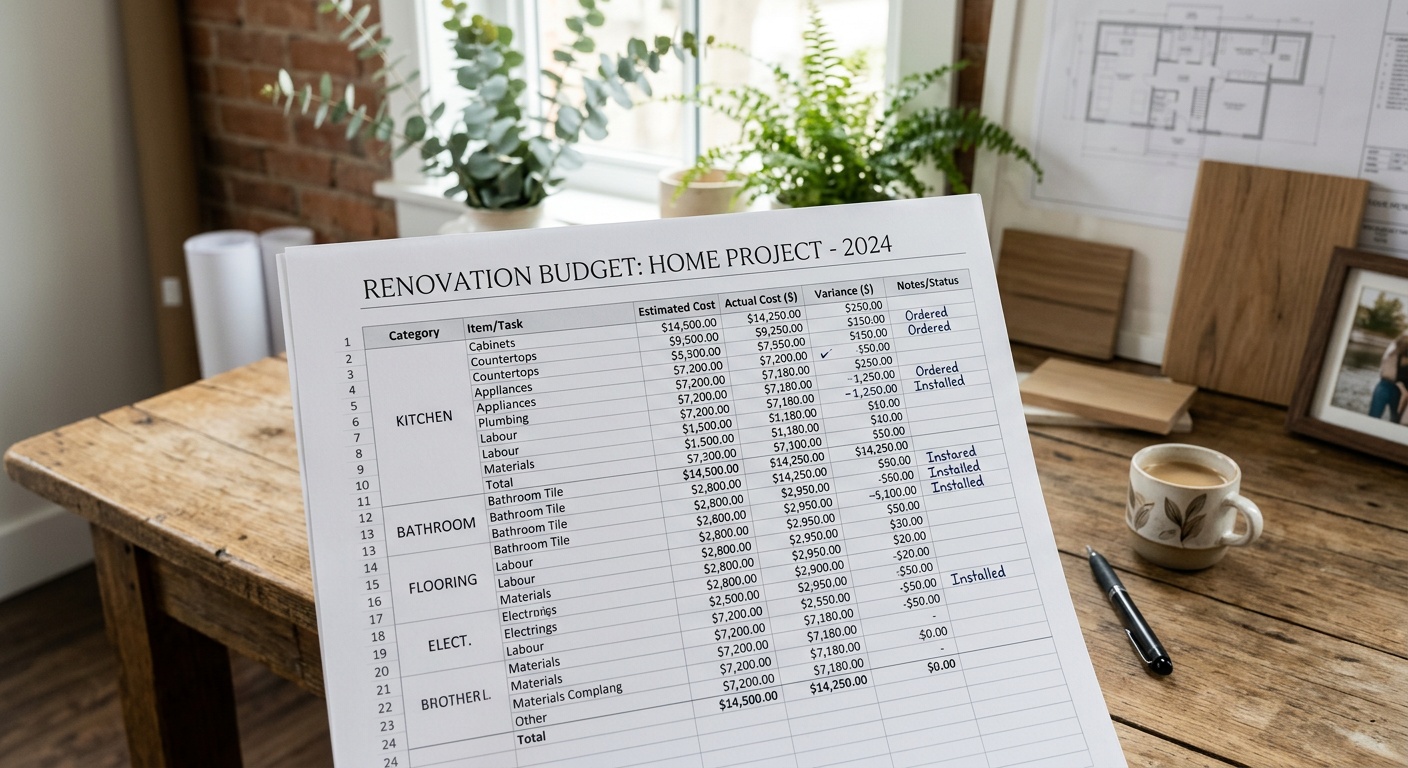
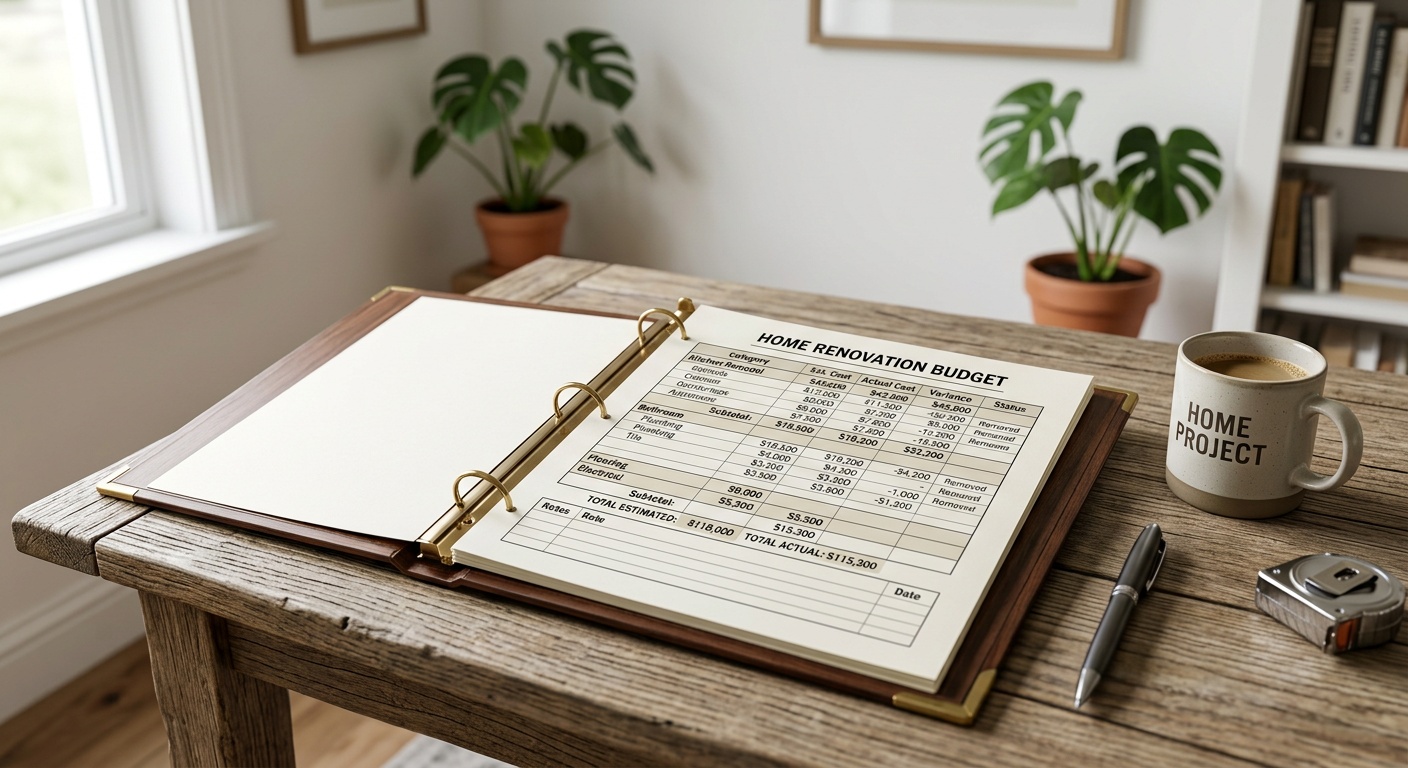
Google Sheets remains the workhorse tool for renovation budgeting. Build columns for: Budget Category, Estimated Cost, Committed Cost (signed contracts), Actual Cost (invoices paid), and Variance. Update it weekly. This single habit prevents bill shock at project completion.
Renovation Management Apps
Houzz Pro, Buildertrend, and CoConstruct are the three most widely used platforms in 2026 for homeowner-contractor collaboration. They offer budget tracking, change order management, and document storage in one place. For projects over $40,000, the organizational value is worth the subscription cost.
AI-Powered Cost Estimators
Tools like Reno AI and HomeAdvisor’s AI Quote Assistant now provide surprisingly accurate preliminary estimates based on ZIP code, project type, square footage, and finish level. Use these as a sanity check before contractor meetings — not as a replacement for professional bids, but as a benchmark to flag outliers.
Renovation Budget as a Percentage of Home Value
A useful guardrail: for most markets, renovation spending beyond 10–15% of your home’s current value is difficult to recover at resale. If your home is worth $380,000, spending $180,000 on renovations is unlikely to add $180,000 in value. This rule of thumb keeps budget ambitions tethered to financial reality.
Here’s a visual breakdown of how homeowners in 2026 are allocating renovation budgets across major project categories, based on the Houzz 2026 U.S. Houzz & Home Study:
2026 Renovation Budget Allocation by Category
Source: Houzz 2026 U.S. Houzz & Home Study
Frequently Asked Questions
How much contingency should I include in a home renovation budget?
The standard recommendation in 2026 is 15–20% of total project cost for most residential renovations. For older homes (pre-1970s), where the likelihood of discovering hidden structural, electrical, or plumbing issues is higher, budget toward the 20% end. For newer construction or purely cosmetic projects, 10–15% may be sufficient. The key is to hold this money in a separate account and only release it against documented, unexpected changes — not scope creep from upgraded choices.
Should I complete all renovations at once or phase them over time?
It depends on your financing situation, how disruptive the work will be to your daily life, and whether interconnected trades need to sequence together. Structural work, electrical, and plumbing must typically be completed together to avoid costly double-mobilization fees. Cosmetic work — painting, flooring, landscaping — can often be phased without penalty. Phasing across multiple years also allows you to save cash between projects, reduce financing costs, and apply lessons from earlier phases to later ones. However, phasing can be costlier overall if the same contractors have to remobilize multiple times.
How do I know if a contractor’s bid is reasonable or too low?
The most reliable signal is comparison: collect at least three bids from licensed, insured contractors who have all reviewed the same scope document. If one bid is more than 20% below the others, treat it as a red flag rather than a bargain. Ask that contractor to explain what assumptions they’re making that others aren’t. Common explanations include using unlicensed subcontractors, excluding permit costs, planning to substitute specified materials, or underestimating hours. In 2026, the cost of a failed or abandoned project far exceeds any upfront savings from a suspiciously low bid.
Your Renovation Budget Playbook: Next Steps
You’ve navigated the full landscape of renovation budgeting. Now let’s make it actionable. Here’s your five-step implementation roadmap to move from planning to project confidence:
- Write your scope document this week. Before any contractor calls, put your project vision in writing — rooms, changes, finish level, non-negotiables. This single document will save you thousands in miscommunication costs.
- Benchmark costs using your local market data. Use AI estimation tools and the national averages in this article as a starting framework, then adjust for your city’s labor index. High-cost metros add 25–40% to national averages.
- Collect a minimum of three itemized bids from licensed, insured contractors — and compare line by line, not just the total.
- Establish your contingency fund separately before you break ground. Open a dedicated savings account today and transfer your 15–20% reserve. Don’t touch it until the unexpected forces you to.
- Set up your budget tracker on Day 1 of the project and commit to a weekly 15-minute update. This single habit is the difference between homeowners who finish on budget and those who don’t.
The broader trend here is significant: as material costs stabilize and AI tools make cost estimation more democratized in 2026, the homeowners who execute renovations successfully aren’t necessarily the ones with the biggest budgets — they’re the ones with the most rigorous planning processes. Financial discipline at the planning stage is the single greatest predictor of renovation satisfaction.
So here’s the question worth sitting with before you pick up that first contractor’s phone number: Are you building a renovation budget to match your dream — or are you building a dream that fits your real financial picture? The best renovation projects start with that honest answer.
Ready to take the next step? Download a free renovation budget template, share this guide with a partner or co-owner who’s part of your decision-making process, and bookmark it as a reference when your project enters the bid phase. Your future self — the one who comes in on budget — will thank you.
About the Author
