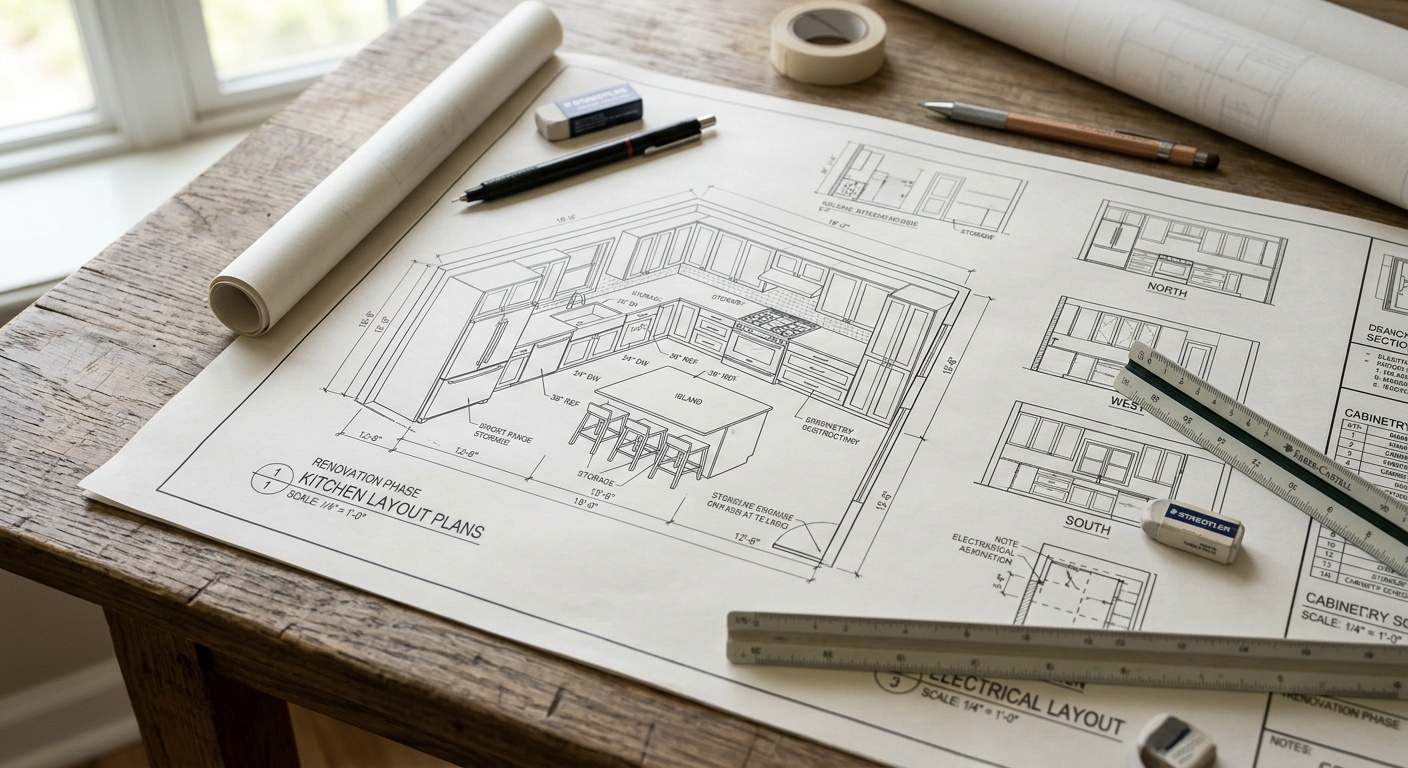
Kitchen Remodel Planning Steps: From Concept to Final Walkthrough
Reading time: 14 minutes
You’ve been staring at those outdated cabinets for two years. The countertop has a crack you’ve covered with a fruit bowl. The lighting makes everything look like a bad crime scene. Sound familiar? A kitchen remodel is one of the most transformative home improvement projects you can undertake — and in 2026, with material costs stabilizing after years of supply chain turbulence, it’s also one of the smartest investments you can make.
But here’s the straight talk: most kitchen remodels go over budget, behind schedule, or both — not because homeowners lack taste, but because they lack a structured planning process. This guide changes that. Whether you’re overhauling a cramped galley kitchen or reimagining an open-concept family hub, the roadmap from concept to final walkthrough is the same. Let’s navigate it together.
Table of Contents
- Defining Your Vision and Budget
- Research, Inspiration, and Design Direction
- Hiring the Right Professionals
- Permits, Timelines, and Logistics
- Managing the Remodel Execution Phase
- Overcoming Common Challenges
- The Final Walkthrough: What to Inspect
- FAQs
- Your Kitchen, Your Roadmap Forward
Step 1: Defining Your Vision and Budget
Before you pin a single image or call a single contractor, you need two things locked in: a clear sense of what you want and a realistic sense of what you can spend. These two elements are in constant conversation throughout your project, and getting them aligned early prevents the painful mid-project compromises that derail so many remodels.
Setting a Realistic Budget in 2026
According to the National Kitchen and Bath Association (NKBA) 2025 Design Trends Report, the average mid-range kitchen remodel in the U.S. costs between $28,000 and $55,000, while upscale remodels regularly exceed $100,000. In 2026, labor costs have risen approximately 8% compared to 2024 due to ongoing skilled-trades shortages, but material costs for cabinetry and countertops have eased by roughly 5–7% as global supply chains have stabilized post-pandemic disruptions.
A practical rule of thumb: allocate 5–15% of your home’s current value to a kitchen remodel. So if your home is worth $450,000, a budget between $22,500 and $67,500 is reasonable. Going significantly above 15% risks diminishing returns on resale value.
Budget breakdown guide (mid-range remodel):
- Cabinetry and hardware: 30–35%
- Labor and installation: 20–25%
- Appliances: 15–20%
- Countertops: 10–12%
- Flooring: 7–10%
- Lighting and electrical: 5–7%
- Contingency fund: 10–15% of total budget
Pro Tip: Never skip the contingency fund. Opening walls in a kitchen built before 1990 has a surprisingly high probability of revealing outdated wiring, water damage, or asbestos — all of which require immediate attention and add unplanned costs.
Clarifying Your Goals: Function vs. Aesthetics
Ask yourself a critical question early: Are you remodeling for daily livability, resale value, or both? These goals can coexist, but they sometimes pull in different directions. A professional chef at home might prioritize commercial-grade appliances and durable surfaces. A homeowner planning to sell in 2027 might prioritize neutral aesthetics and broad buyer appeal over personal preferences.
Write a simple “kitchen mission statement.” For example: “We need a kitchen that can handle family dinners for 6, integrates open-plan entertaining, and appeals to buyers if we sell in three years.” This single sentence will guide hundreds of small decisions later.
Step 2: Research, Inspiration, and Design Direction
Now comes the part most homeowners enjoy most — and also the part where scope creep quietly begins. Inspiration is valuable; inspiration without structure is expensive.
In 2026, design platforms like Houzz, Pinterest, and emerging AI-powered room visualization tools have made it easier than ever to explore styles. But the sheer volume of options can lead to decision paralysis or, worse, a Frankenstein kitchen that blends too many styles incoherently.
Productive research strategies:
- Create two separate boards: one for “love everything” and one for “specific elements I want.” The second board is what you’ll actually bring to contractors.
- Note the why behind each saved image. Is it the color palette, the storage solution, the lighting? This helps you extract principles rather than copying entire designs.
- Visit kitchen showrooms in person. Photographs lie — material textures, drawer quality, and hardware weight only reveal themselves in person.
- Research your neighborhood. A $150,000 designer kitchen in a neighborhood where homes sell for $300,000 will never recoup its investment.
2026 design trends worth noting: Warm wood tones paired with stone surfaces continue to dominate. Integrated appliances (panel-ready refrigerators, hidden dishwashers) are becoming standard in mid-range remodels. Smart kitchen technology — including AI-assisted cooking hoods, touchless faucets, and voice-integrated lighting — is now expected rather than exceptional. Sustainability is also a growing factor: 62% of homeowners in a 2025 Houzz survey said eco-friendly materials influenced their remodel decisions.
Step 3: Hiring the Right Professionals
This is where many homeowners make their most consequential mistake: choosing professionals based primarily on price rather than fit, track record, and communication style.
Let’s be direct. A kitchen remodel involves multiple trades — general contractors, electricians, plumbers, tile setters, cabinet installers — who must coordinate precisely. The person orchestrating this is either your general contractor (GC), a kitchen designer, or you yourself. Each approach has tradeoffs.
Understanding Your Professional Options
| Professional Type | Best For | Typical Cost (2026) | Key Advantage | Main Risk |
|---|---|---|---|---|
| General Contractor | Full gut remodels | 15–25% of project cost | Manages all trades | Less design input |
| Kitchen Designer + GC | Complex layouts, custom work | $3,000–$12,000 design fee | Expert design + execution | Higher upfront cost |
| Design-Build Firm | Streamlined projects | Premium pricing | Single point of contact | Less flexibility mid-project |
| DIY + Subcontractors | Experienced homeowners | Material cost only | Maximum savings | High time investment, liability |
| Kitchen Cabinet Retailer | Cabinet-focused refreshes | Variable | Bundled design service | Limited to their product line |
Case Study — The Martinez Family (Chicago, IL, 2025): Sarah and Carlos Martinez attempted a full kitchen gut remodel using only individual subcontractors they found online to save the GC’s 20% fee. Eight months and $14,000 in coordination errors later, they hired a GC anyway. The lesson: on projects involving plumbing, electrical, and structural changes simultaneously, professional orchestration typically pays for itself in avoided mistakes.
How to vet contractors effectively:
- Request a minimum of three references from projects completed within the past 18 months
- Verify licensing and insurance independently — don’t accept copies of documents at face value
- Ask specifically: “What happens when something unexpected is discovered inside a wall?” Their answer reveals their integrity
- Get at least three competing bids and review line items, not just totals
- Check their current project load — a contractor with no availability for six months may be high-quality, but one who can start immediately in a busy season warrants scrutiny
Step 4: Permits, Timelines, and Logistics
Permits are the unglamorous backbone of a compliant remodel. Skipping them might save a few hundred dollars and a few weeks — until you try to sell your home and a sharp buyer’s inspector discovers unpermitted electrical work, resulting in costly remediation or a collapsed sale.
In most U.S. jurisdictions in 2026, kitchen remodels require permits when they involve:
- Moving or adding electrical circuits
- Relocating plumbing supply or drain lines
- Removing or altering load-bearing walls
- HVAC duct modifications
- Gas line work
Cosmetic changes — painting, replacing fixtures in the same location, swapping appliances — typically don’t require permits. Your contractor should pull all required permits; if they suggest you do it yourself to “save money,” that’s a red flag about how they plan to handle inspections.
Building a Realistic Project Timeline
One of the most frequent sources of homeowner frustration is underestimating how long a kitchen remodel takes from start to livable completion. Here’s a realistic 2026 timeline breakdown for a mid-range full remodel:
- Planning and design phase: 4–8 weeks
- Contractor selection and contracts: 2–4 weeks
- Permits and approvals: 2–6 weeks (varies dramatically by municipality)
- Material lead times: Custom cabinets: 6–12 weeks; semi-custom: 4–8 weeks; stock: 1–2 weeks
- Demolition: 1–3 days
- Rough-in work (plumbing, electrical, HVAC): 1–2 weeks
- Inspections: 1–5 days per inspection
- Cabinet installation: 1–3 days
- Countertop template and fabrication: 1–3 weeks post-cabinet install
- Tile, flooring, painting: 1–2 weeks
- Appliance installation and punch-list: 3–5 days
Total realistic timeline: 3–6 months from first planning conversation to final walkthrough. Projects with custom features or structural changes regularly extend to 7–9 months.
Logistics tip: Plan your temporary kitchen setup before demolition begins. A microwave, electric hot plate, coffee maker, and small refrigerator in a spare room or garage keeps daily life functional during the 4–8 weeks your kitchen is inaccessible.
Step 5: Managing the Remodel Execution Phase
Construction has started. The walls are open. Your home smells like sawdust. This is where your role shifts from planner to informed project monitor. You don’t need to be on-site constantly — in fact, hovering can slow progress — but you do need structured oversight.
Effective oversight practices:
- Schedule a brief weekly check-in with your GC — not more, not less. Ad-hoc daily contact creates noise; weekly structured updates maintain accountability.
- Document everything with dated photographs. Walk through each evening when workers have left and photograph completed work, especially rough-in work before it’s covered.
- Keep a running decision log. Remodels involve dozens of small decisions — tile grout color, hardware finish, outlet placement. Document each decision with date and who approved it.
- Process change orders immediately and in writing. Verbal agreements during remodels are how disputes begin. A change order, no matter how small, should be documented with cost and timeline implications.
- Review your payment schedule. A common structure is 10% upon signing, followed by milestone-based payments, with 10–15% retained until final walkthrough and punch-list completion. Never pay more than the work completed.
Case Study — The Okonkwo Renovation (Atlanta, GA, 2026): James Okonkwo’s kitchen remodel was tracking well until the cabinet installation revealed his contractor had ordered the wrong finish on upper cabinets — a $3,200 error. Because James had documented the original specification in a signed change order, the contractor absorbed the cost of replacement. Without that documentation, the dispute would have been impossible to resolve cleanly. Paperwork feels tedious until it saves thousands of dollars.
Step 6: Overcoming Common Challenges
Even the best-planned kitchen remodels encounter turbulence. Here are the three most common challenges in 2026 and how to navigate them strategically.
Challenge 1: Unexpected Structural or Systems Issues
Opening walls in homes built before 2000 — and even many built after — frequently reveals outdated electrical panels, galvanized plumbing prone to corrosion, inadequate ventilation systems, or moisture damage. A 2025 survey by HomeAdvisor found that 67% of full kitchen remodels in homes over 20 years old encountered at least one significant unexpected issue adding $2,000–$15,000 to the project cost.
Strategy: This is precisely why your 10–15% contingency fund is non-negotiable. Additionally, in older homes, consider having a plumber and electrician do a preliminary assessment — even before finalizing your remodel scope — to surface major issues before they become mid-construction emergencies.
Challenge 2: Decision Fatigue and Scope Creep
A kitchen remodel involves hundreds of decisions: cabinet style, finish, hardware, countertop material and edge profile, backsplash tile pattern and grout color, paint color, flooring, lighting fixtures, outlet placement, appliance models. Decision fatigue is real, and it leads to either rushed choices you’ll regret or the paralysis that extends timelines.
Strategy: Make all material and fixture selections before construction begins. This is non-negotiable. Contractors call these “selections complete” — meaning every product that needs to be ordered has been specified and ordered. Changes after construction starts cost 3–5x more than changes made during planning.
Challenge 3: Contractor Communication Breakdowns
Communication failures between homeowners and contractors — or between subcontractors themselves — cause more project delays and disputes than any other single factor. The problem typically isn’t bad intentions; it’s assumptions.
Strategy: Establish communication protocols at project kickoff: preferred communication channel (text, email, project management app), response time expectations, and a defined process for urgent issues vs. routine updates. Apps like Buildertrend, CoConstruct, or even a dedicated group thread with documented decisions create a shared record that protects everyone.
Step 5 Continued: The Visualization — Where Your Budget Goes
Understanding budget allocation visually helps prioritize where to invest and where to scale back. Here’s how a typical mid-range kitchen remodel budget breaks down:
Kitchen Remodel Budget Allocation (Mid-Range, 2026)
Step 7: The Final Walkthrough — What to Inspect
The final walkthrough is not a celebration — it’s an inspection. Bring a checklist, a flashlight, and a critical eye. This is your last opportunity to identify deficiencies before releasing your final payment.
Final walkthrough checklist:
- Cabinetry: All doors and drawers open, close, and align correctly. Soft-close mechanisms work. No visible gaps, scratches, or finish inconsistencies. Interior shelves are level and secure.
- Countertops: No chips, cracks, or visible seams that don’t match the approved sample. Overhang is consistent. Backsplash meets countertop cleanly without gaps.
- Plumbing: Run all faucets. Check under the sink for leaks. Test garbage disposal. Confirm dishwasher completes a full cycle without error codes.
- Electrical: Test every outlet with a phone charger. Test all switches and confirm they control the correct fixtures. Verify all GFCI outlets near water sources are working and properly located.
- Appliances: Power on every appliance and run through basic functions. Test oven temperature accuracy. Confirm hood fan operates at all speeds.
- Tile and grout: Walk slowly across flooring and tap tiles — hollow sounds indicate improper adhesion. Check grout lines for consistency and completeness. No cracked tiles.
- Paint and trim: No drips, brush marks, or missed coverage areas. Trim is caulked and painted. No paint on hardware or tile.
- Lighting: All fixtures are level and secure. Recessed lights are all the same depth. Under-cabinet lighting operates correctly.
- Cleanup: All construction debris removed. Windows cleaned. All protective film removed from appliances and surfaces.
Compile a punch list — a written list of all items needing correction — and agree with your contractor on a completion date before releasing the final payment. A standard practice is to hold 5–10% of the total contract price until the punch list is fully resolved.
As renowned kitchen designer Ellen Cheever, CMKBD, has noted: “The final walkthrough separates the project from the relationship. Approach it professionally, document everything, and you protect both parties.”
Frequently Asked Questions
How long does a typical kitchen remodel take from start to finish in 2026?
For a mid-range full kitchen remodel in 2026, realistically plan for 4–6 months from initial planning to final walkthrough. This includes 4–8 weeks of design and planning, 2–6 weeks for permits, 6–12 weeks for custom cabinet lead times, and 4–6 weeks of active construction. Projects involving structural changes, custom cabinetry, or complex tile work regularly extend to 7–9 months. The biggest timeline variable is often permitting, which varies dramatically by municipality — some jurisdictions now offer digital permit submissions that process in days, while others still require weeks. Build buffer time into your expectations from day one.
Should I stay in my home during a kitchen remodel or move out temporarily?
For most mid-range remodels lasting 4–8 weeks of active construction, staying home is feasible with a properly set up temporary kitchen. Key necessities include a microwave, electric kettle, small refrigerator, and a utility sink access point. However, if your remodel involves significant demolition that will generate heavy dust, disturb lead paint (common in homes built before 1978), or if you have young children or respiratory conditions, temporary relocation for the demo and rough-in phase — typically 1–2 weeks — is genuinely worth the cost. Many contractors now offer dust containment systems that meaningfully reduce airborne particles, but they’re not perfect. Discuss your situation honestly with your contractor before construction begins.
What is the ROI on a kitchen remodel in 2026, and does it make sense financially?
According to the 2025 Remodeling Cost vs. Value Report, a mid-range major kitchen remodel recoups approximately 68–72% of its cost at resale in most U.S. markets. Minor kitchen remodels (cabinet refacing, new appliances, countertop replacement without layout changes) perform better at 80–85% cost recovery. This means a $40,000 mid-range remodel adds approximately $27,000–$29,000 to your home’s market value. The financial case is strongest when: your kitchen is significantly below neighborhood standard, you plan to enjoy the space for 3–7 years before selling, and you’re making functional improvements (adding storage, improving workflow) alongside aesthetic ones. If you’re remodeling purely for resale within 12 months, a targeted refresh — not a full gut remodel — typically offers better returns.
Your Kitchen, Your Blueprint Forward
Here’s the bigger picture: a kitchen remodel is one of the few home improvement projects that genuinely improves your daily quality of life and your home’s long-term value simultaneously. In 2026, as homeowners increasingly invest in spaces that serve multiple functions — cooking, working, socializing, entertaining — a well-planned kitchen remodel isn’t just renovation, it’s infrastructure for how you actually live.
Let’s bring this home with your practical next steps:
- This week: Write your “kitchen mission statement” and establish your budget range using the 5–15% of home value guideline. Pull your home’s current market value from Zillow, Redfin, or a quick agent consultation.
- Within 30 days: Build your inspiration file with the dual-board system (love everything vs. specific elements), and visit at least two kitchen showrooms in person. Begin researching certified kitchen designers and general contractors in your area.
- Within 60 days: Have first consultations with 2–3 professionals. Ask the tough questions about timeline, communication protocols, and what happens when surprises are found inside your walls.
- Before any contract is signed: Confirm all permits required, verify contractor licensing and insurance independently, and ensure your selections are 100% complete before construction begins.
- Throughout construction: Document everything in writing, photograph daily progress, and protect your final payment until every item on your punch list is resolved.
The most successful kitchen remodels aren’t the ones with the biggest budgets — they’re the ones with the most disciplined planning processes. As smart home technology continues to integrate with kitchen design and sustainability expectations rise through 2027 and beyond, the kitchens built with genuine intentionality today will be the ones that age best.
So here’s the question worth sitting with: What would your kitchen need to look like, function like, and feel like for it to genuinely be the heart of your home — and are you ready to build that vision with the same strategic care you’d bring to any major life investment?
About the Author
