Basement Waterproofing Options: Membranes, Panels, and Contractor Hiring Tips
Reading time: 14 minutes
Picture this: You walk downstairs one morning to find a damp patch creeping across your basement wall, a musty smell hanging in the air, and the quiet dread of wondering how long this has been happening behind your back. Sound familiar? You’re far from alone. In 2026, basement water intrusion remains one of the most reported — and most costly — home maintenance issues across North America and Europe, affecting an estimated 60% of homes with below-grade spaces at some point in their lifespan.
The good news? Waterproofing technology has evolved dramatically. Whether you’re dealing with minor seepage or a full-scale flooding problem, there’s a solution calibrated precisely to your situation — and a right way to hire someone to install it. This guide cuts through the noise and gives you the strategic roadmap you need to protect your home, your investment, and your peace of mind.
Table of Contents
- Why Basement Waterproofing Matters in 2026
- Understanding Water Intrusion: Know Your Enemy
- Waterproofing Membranes: The First Line of Defense
- Drainage Panels and Interior Systems
- Side-by-Side: Comparing Waterproofing Methods
- Cost & Effectiveness at a Glance
- Hiring a Waterproofing Contractor: The Smart Approach
- Real-World Case Studies
- Frequently Asked Questions
- Your Dry Basement Action Plan
Why Basement Waterproofing Matters in 2026
Waterproofing isn’t glamorous. It doesn’t show up on Instagram remodels or home tour videos. But it is, arguably, the single most important protective investment you can make in your home. Here’s why it deserves your full attention right now.
According to the National Association of Home Builders (NAHB), water damage is the leading cause of structural deterioration in residential buildings. As of 2026, climate volatility has intensified precipitation patterns across much of the continental United States, with a 22% increase in extreme rainfall events recorded since 2020. That means more water pressure on your foundation walls, more hydrostatic stress, and more opportunities for water to find its way in.
Beyond the structural risks, consider the financial stakes. The average cost of repairing water-damaged basements — including mold remediation, structural repairs, and personal property losses — reached $11,400 in 2025, according to HomeAdvisor’s annual damage report. Compare that to the cost of proactive waterproofing, which typically ranges from $3,000 to $15,000 depending on method and scope, and the math becomes very clear.
There’s also the health dimension. Mold thrives in moisture-compromised basements, and the CDC estimates that indoor mold exposure contributes to respiratory problems in millions of Americans annually. Waterproofing isn’t just about protecting your home — it’s about protecting the people who live in it.
Understanding Water Intrusion: Know Your Enemy
Before you can choose the right solution, you need to understand the problem. Water enters basements through several distinct pathways, and each one requires a targeted response.
Types of Water Intrusion
1. Hydrostatic Pressure: When the soil surrounding your foundation becomes saturated, it exerts enormous outward-then-inward pressure on your walls. This is the silent force behind most foundation cracks. It’s particularly prevalent in clay-heavy soils that retain water rather than allowing it to drain.
2. Surface Water Runoff: Rainwater that doesn’t drain away from your home’s perimeter will eventually pool against the foundation and seep through porous concrete or masonry. Improper grading (land that slopes toward the house rather than away) is a common culprit.
3. Window Well Leakage: Basement windows are notorious weak points. If window wells aren’t properly drained and sealed, they become collection reservoirs that drive water directly through your walls.
4. Cove Joint Seepage: The joint where your basement floor meets the wall is called the cove joint. Under hydrostatic pressure, water can push up through this gap — a problem that interior sealants alone cannot solve.
5. Wall Cracks: Shrinkage cracks in poured concrete, mortar joint failures in block walls, and structural cracks from settlement all create direct pathways for water intrusion.
Diagnosing Your Specific Problem
Here’s a simple field test before you call anyone: tape a piece of aluminum foil tightly against a damp basement wall. Leave it for 24–48 hours. If moisture appears on the outside of the foil (between the foil and your hand), the problem is condensation — a ventilation issue, not a waterproofing one. If moisture appears on the inside of the foil (against the wall), water is actively migrating through the wall, and you have a genuine intrusion problem that requires waterproofing intervention.
This distinction matters enormously. Many homeowners spend thousands on waterproofing systems when what they actually needed was a dehumidifier and better ventilation. A proper diagnosis saves you from mismatched — and costly — solutions.
Waterproofing Membranes: The First Line of Defense
Membranes are the gold standard of exterior basement waterproofing. Applied to the outside face of your foundation wall, they create a continuous barrier that prevents water from ever reaching the concrete itself. Think of them as a raincoat for your foundation.
Types of Waterproofing Membranes
Cementitious Waterproofing: This is the most accessible option for DIYers and the most budget-friendly professional solution. A cement-based compound is mixed and applied directly to masonry or concrete surfaces. It bonds chemically with the substrate, creating a rigid, waterproof layer. It handles positive-side pressure well but can crack with building movement. Best for: interior applications on stable walls, water tanks, swimming pools.
Bituminous (Asphalt-Based) Membranes: These have been workhorses of the waterproofing industry for decades. Applied either as a liquid coating or as self-adhesive sheets, bituminous membranes offer excellent flexibility and adhesion to concrete. However, UV exposure degrades them rapidly — they must be covered with backfill or protection boards. Best for: exterior foundation walls, below-grade applications.
Sheet-Applied Membranes: Modern sheet membranes — including HDPE (high-density polyethylene) and EPDM rubber sheets — offer superior durability and consistency of coverage. Unlike spray-applied coatings, sheets provide a measurable, verifiable thickness. In 2026, self-adhering sheet membranes with integrated protection layers have become the contractor preference for new construction and serious renovations. Brands like GRACE Bituthene, Sika Waterbar, and Henry Company’s Blueskin lead the market.
Liquid-Applied Membranes: These are polymer-based coatings sprayed or rolled onto the exterior wall surface. They cure into a seamless, flexible film that bridges minor cracks and surface irregularities. Modern formulations in 2026 include reactive polyurethane and crystalline-modified compounds that actually grow into cracks over time — a technology called crystalline waterproofing that deserves special attention.
Crystalline Waterproofing Technology: This is arguably the most exciting development in the field over the past decade. Crystalline compounds contain active chemicals that react with water and cement particles to form insoluble crystals within the concrete matrix itself. These crystals fill capillary pores and micro-cracks, effectively making the concrete self-sealing. Products like Xypex and Kryton’s Krystol have been proven in infrastructure projects globally. The remarkable advantage: the crystals remain dormant and reactivate whenever moisture re-enters — a self-healing system that improves over time.
When to Choose Exterior vs. Interior Membrane Application
Exterior application is always the preferred approach — it stops water before it contacts your structure. However, it requires excavating around your foundation, which is expensive, disruptive, and not always feasible in urban settings or with established landscaping. Interior membrane systems (applied to the inside surface of basement walls) redirect water that has already penetrated, channeling it to a drainage system. They don’t stop moisture from entering the wall, but they prevent it from entering your living space.
Pro Tip: In 2026, many contractors offer a hybrid approach: interior crystalline treatment on walls (which actually penetrates and fortifies the concrete from within) combined with an interior drainage channel system. This is often the most cost-effective solution when exterior excavation isn’t practical.
Drainage Panels and Interior Systems
When water has already found a way into your basement — or when exterior work isn’t viable — interior drainage systems become the strategic solution. Rather than trying to stop water, these systems manage and redirect it efficiently.
Dimple Mat Drainage Panels
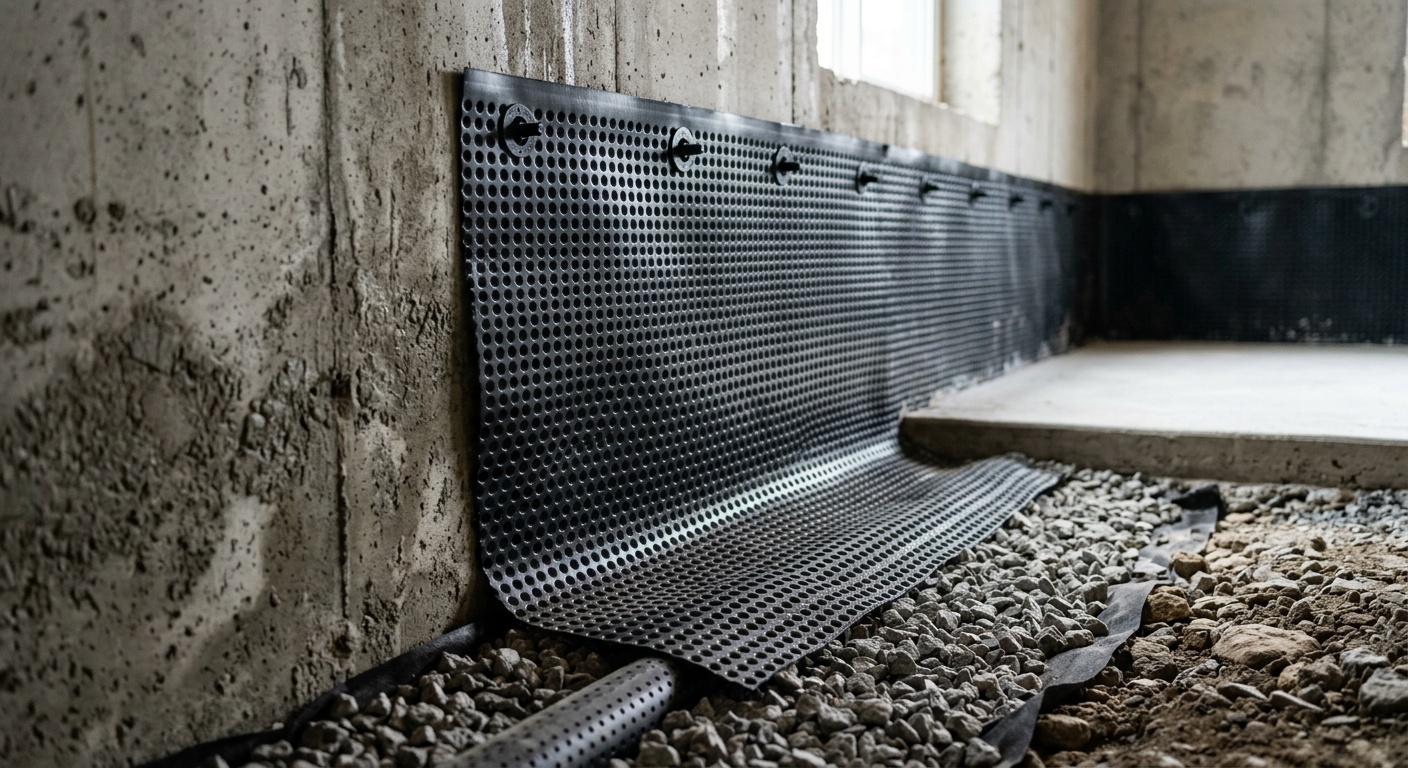
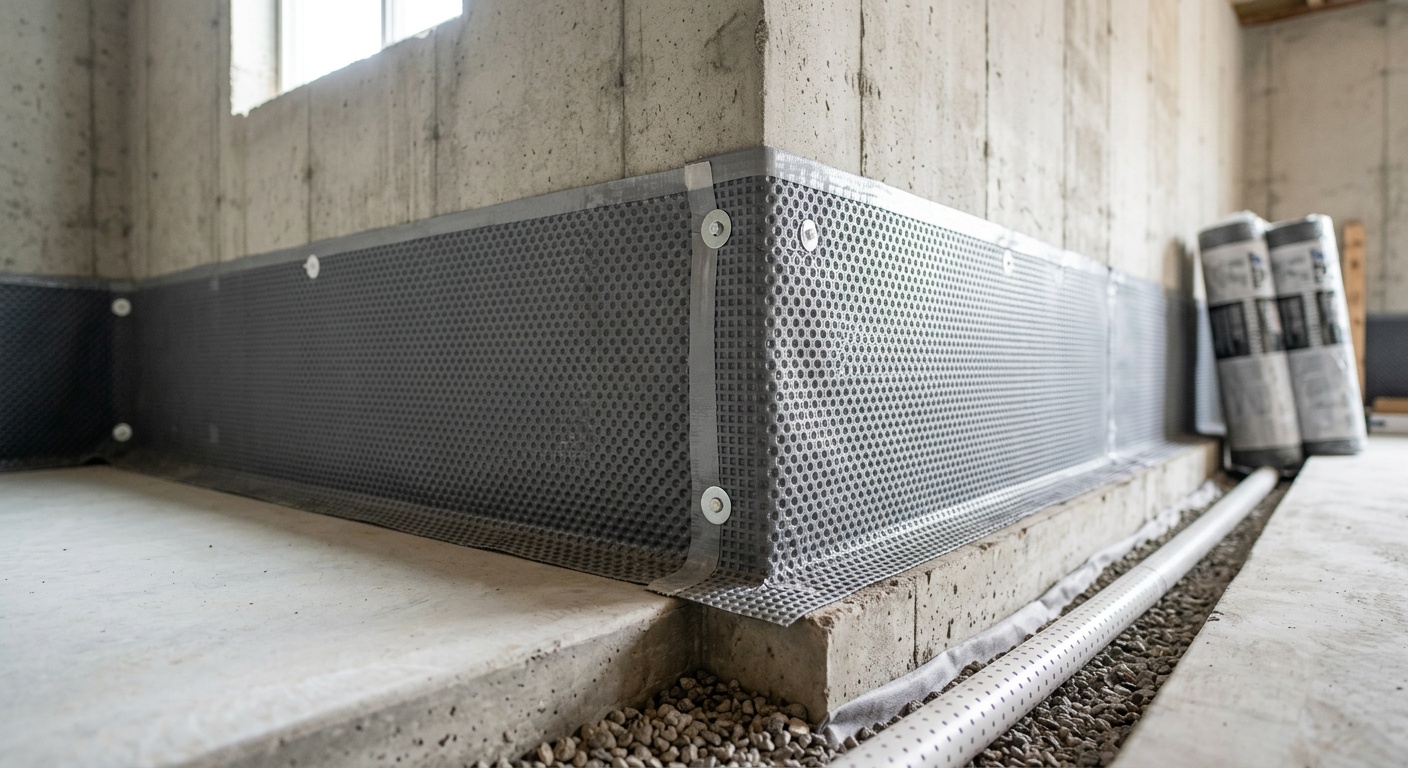
Dimple mats (also called drainage boards or studded membranes) are sheets of HDPE plastic with hundreds of small raised studs or “dimples” that create an air gap between the panel and the wall or floor. This gap serves as a drainage channel, allowing water that penetrates the wall to flow downward rather than spreading across your floor or into your living space.
When installed on walls, dimple mats are typically paired with a footer drain channel that runs along the base of the wall and directs water to a sump pump. The system is hidden behind finishing materials — drywall, paneling, or framing — making it completely invisible in a finished basement.
Key advantages of dimple mat systems:
- No excavation required — fully interior installation
- Creates a thermal break, reducing condensation
- Allows trapped moisture to escape, preventing wall deterioration
- Can be installed in a single weekend in smaller basements
- Cost-effective: typically $1.50–$3.50 per square foot for materials alone
French Drain and Perimeter Channel Systems
The interior French drain (or weeping tile system) is the workhorse of basement waterproofing. A channel is cut around the perimeter of your basement floor, a perforated pipe is laid in a bed of gravel, and the whole system is covered with concrete. Water entering through the cove joint or walls drains into this channel, flows to a sump pit, and is pumped out by a sump pump.
Modern versions of this system use specialized channel products like WaterGuard (from Basement Systems) or B-Dry’s patented wall anchors that mount above the footing, preventing the pipe from clogging with silt over time — a common failure point in older systems.
In 2026, battery backup sump pumps have become essentially non-negotiable. Given the increase in power outages during severe weather events (precisely when your sump pump is most needed), a backup system provides insurance when you need it most. Combination primary/backup units from brands like Zoeller and Wayne now integrate with home automation systems, sending alerts to your smartphone when water levels rise or when the backup activates.
Side-by-Side: Comparing Waterproofing Methods
| Method | Average Cost (per linear ft.) | Effectiveness | Disruption Level | Lifespan |
|---|---|---|---|---|
| Exterior Membrane | $80–$150 | ⭐⭐⭐⭐⭐ (Excellent) | High (excavation) | 20–30 years |
| Crystalline Treatment | $10–$25 | ⭐⭐⭐⭐ (Very Good) | Low (interior) | Lifetime of structure |
| Interior French Drain | $50–$100 | ⭐⭐⭐⭐ (Very Good) | Moderate (floor cuts) | 15–25 years |
| Dimple Mat System | $30–$60 | ⭐⭐⭐ (Good) | Low (wall-mounted) | 10–20 years |
| Cementitious Coating | $5–$15 | ⭐⭐ (Moderate) | Very Low | 5–10 years |
Cost & Effectiveness at a Glance
The chart below visualizes the relative effectiveness ratings of the five primary waterproofing methods, scored on a 10-point scale based on long-term water management performance in 2025–2026 field studies.
Effectiveness Score by Waterproofing Method (out of 10)
Hiring a Waterproofing Contractor: The Smart Approach
This is where many homeowners make their most expensive mistakes. The waterproofing industry — despite having excellent professionals — also harbors high-pressure sales tactics, inflated quotes, and solutions that are oversized for the actual problem. Here’s how to navigate the selection process with confidence.
Red Flags to Watch For
Before you even begin collecting quotes, internalize these warning signs:
- The one-day sales pressure: Any contractor who tells you the price is only valid “if you sign today” is using a manipulation tactic. Legitimate contractors don’t disappear if you take a week to compare options.
- Recommending exterior excavation as a first resort: This is the most expensive option. A reputable contractor assesses your situation thoroughly before recommending it. If your first quote jumps straight to exterior waterproofing, get additional opinions.
- Vague warranties: The industry standard in 2026 is a transferable lifetime warranty on interior drainage systems. If a contractor offers only a 1–5 year warranty, that’s a significant red flag about their confidence in the work.
- No license or insurance: Waterproofing involves structural work. In most states and provinces, contractors must be licensed as general contractors or specialty contractors. Ask for documentation and verify it with your local licensing board.
- Inability to explain the diagnosis clearly: A professional can articulate exactly why water is entering and how their proposed solution addresses that specific cause. If the explanation is vague, so will the results be.
The Right Interview Questions
Treat contractor selection like a job interview — because it is one. Ask these questions directly:
- “Can you show me exactly where the water is entering and why?” — They should be able to point to specific evidence.
- “Is your warranty transferable to the next homeowner?” — This matters for resale value.
- “Who specifically will be doing the work — your employees or subcontractors?” — Subcontracting is common but you want to know upfront.
- “Can you provide references from projects completed in the last 12 months in this area?” — Local references from recent work are more relevant than distant or dated ones.
- “What happens if water returns after your system is installed?” — Their answer reveals the quality of their warranty commitment.
Getting and Comparing Quotes
Collect a minimum of three written quotes before making any decision. Ensure each quote specifies the exact materials being used (brand names, product specifications), the scope of work in measurable terms (linear feet of drainage channel, square footage of membrane), the warranty terms in writing, and a clear payment schedule that does not require more than 10–20% upfront.
Be cautious of quotes that are dramatically lower than others — they often involve inferior materials or shortcuts in preparation. Similarly, the highest quote isn’t automatically the best. Look for the quote that most clearly articulates the problem, the solution, and the accountability structure.
Real-World Case Studies
Case Study 1: The Cleveland Homeowner Who Almost Over-Spent
In early 2025, a homeowner in Cleveland, Ohio contacted three waterproofing companies after noticing seasonal water stains along two basement walls. The first company quoted $22,000 for full exterior excavation and membrane installation. The second quoted $14,500 for an interior French drain system around the entire perimeter. The third contractor — a smaller, independent firm — diagnosed the actual problem: two specific wall cracks were allowing water in during heavy rains, and the exterior grading directed water toward the house.
The third contractor’s solution: injection grouting of the cracks ($800), exterior downspout extensions ($200), and regrading a small section of yard ($1,100). Total: $2,100. The homeowner had the work done in spring 2025 and reported zero water issues through the following year’s rainy season. The lesson: accurate diagnosis prevents massive over-spending.
Case Study 2: The Toronto Renovation That Got It Right
A couple renovating a 1960s home in Toronto’s East End in 2026 took a proactive approach before finishing their basement. They hired a certified waterproofing inspector (separate from any contractor) to assess the space before any work began. The inspector identified hydrostatic pressure issues common to clay-soil neighborhoods in that area and recommended a comprehensive interior system.
They selected a contractor with 20+ years of local experience who installed a perimeter French drain, a dual sump pump system with battery backup, and dimple mat protection on the lower 4 feet of all walls. Total cost: $9,800 with a transferable lifetime warranty. The couple then finished the basement as a rentable apartment — a project that now generates $1,800/month in rental income, with full confidence in the waterproofing beneath the drywall.
Frequently Asked Questions
How do I know if I need interior or exterior waterproofing?
The choice depends on the source and severity of water intrusion, your budget, and site constraints. Exterior waterproofing is the most comprehensive solution and is best applied during new construction or when major excavation is already planned. Interior systems are more practical and cost-effective for existing homes where exterior access is difficult, landscaping is established, or neighboring structures are close. For most homeowners dealing with moderate water issues, a quality interior French drain and sump system provides excellent, long-term results without the disruption and cost of excavation. Always get a professional diagnosis before committing to either direction.
What is the average lifespan of a waterproofing membrane?
It varies significantly by product type. Exterior bituminous sheet membranes typically perform well for 20–30 years when properly installed and covered with protection board before backfilling. Liquid-applied polyurethane membranes have a similar range. Crystalline treatments, by contrast, are considered permanent — they become part of the concrete itself and don’t have a finite service life. Interior drainage systems have mechanical components (sump pumps) that require maintenance every 3–5 years, while the channel infrastructure typically lasts 20–25 years. The quality of installation affects longevity just as much as material choice.
Can I waterproof my basement myself to save money?
Some elements are genuinely DIY-friendly: applying crystalline waterproofing coatings to interior walls, extending downspouts, regrading soil away from the foundation, and installing window well covers. These can address minor seepage and condensation at relatively low cost. However, full membrane systems, interior French drains, and sump pump installation involve structural considerations, building permits in many jurisdictions, and technical skills that most homeowners lack. A botched DIY waterproofing job can actually trap moisture inside walls, accelerating deterioration rather than preventing it. Invest in professional assessment at minimum, even if you do some of the remedial work yourself.
Your Dry Basement Action Plan
You now have the framework to stop guessing and start acting strategically. Here’s your step-by-step path forward:
- Diagnose before you spend. Use the foil test and visual inspection to differentiate condensation from genuine intrusion. Document the location, timing, and severity of any water you find.
- Match the solution to the problem. Minor cracks and surface seepage may need nothing more than injection grouting and grading corrections. Chronic hydrostatic pressure demands a system approach — membrane, drainage, and sump.
- Get three quotes from licensed, insured contractors. Ask every question in this guide. Demand written, transferable warranties. Don’t let anyone pressure you into signing on the spot.
- Prioritize the sump pump system regardless. Even with an excellent membrane, a battery-backed sump pump is cheap insurance against extreme weather events — now a near-annual reality in most of North America.
- Treat waterproofing as an investment, not an expense. A properly waterproofed basement adds usable square footage, protects your home’s structural integrity, and can increase resale value by 10–15% according to 2025 real estate data from the National Association of Realtors.
As climate patterns continue shifting and extreme rain events become more frequent through 2027 and beyond, the homes that weather those storms without damage will be the ones whose owners made smart, proactive waterproofing decisions today. Basement waterproofing has moved from a reactive repair item to a fundamental element of future-proof homeownership.
So here’s the question worth sitting with: If water found a way into your basement tonight, would your home be ready — or would you be calling a contractor in a panic at twice the price? The best time to waterproof is before you need to. That time, for most homes, is right now.
About the Author
